
My dog is a working-line herding mix, which is a polite way of saying he has the energy budget of a small generator and the attention span of a toddler on a sugar high. Walks do not tire him out. Two walks, plus fetch, plus fifteen minutes of training — that tires him out. The thing that actually exhausts him, more than any of those, is making him think.
So when a friend who runs a rescue told me she kept a cheap slide puzzle in every kennel for the high-energy dogs, I bought one. The DR CATCH Dog Puzzle Toy was the one she recommended, on the theory that an affordable puzzle you replace yearly is better than an expensive one you baby.
Here is the 30-day diary.
Day 1: humility
The DR CATCH is a flat plastic board with 16 compartments — eight sliders and eight flip-up lids. You hide kibble under the pieces, the dog has to slide or flip to get to it. It is, in design terms, about as complicated as a toddler's shape sorter.
My dog took one look at it, shoved the whole board across the floor with his nose, and ate the kibble that fell out of the compartments that popped open from the impact. Total engagement: 45 seconds.
I made a note. Day 1 was a failure, but it was a failure of setup, not of the toy. I had loaded every compartment, which made the puzzle trivial because every nudge of the board released food. The reward came too easy.
Day 2-7: the loading matters
I changed my approach. I loaded only four compartments — the flip-up ones, which require more deliberate paw work than the sliders. The other twelve I left empty.
This worked. Now the board didn't release food when he shoved it. He had to actually target a specific flip lid and paw it open. By day 4 he had a technique: left paw for the left-side lids, right paw for the right-side, a downward swat rather than a sideways push. By day 7 he was clearing the four loaded compartments in about 90 seconds and then sitting at the board looking at me, because the other twelve were empty and that was, in his view, a problem I needed to fix.
Week 2: full load, real work
By week 2 I loaded all 16. This is where the puzzle earned its keep. With every compartment loaded, he had to remember which sliders he had already cleared (because the slider covers a fixed track, you can't re-check a compartment you've already opened) and which flip lids he had not yet hit. He worked the board for about six minutes, got visibly tired, and then went and lay down under the desk.
That is the whole point. A tired dog is a good dog.
Week 3: the boredom curve
Here's the honest part. By day 18, he was clearing the full board in under three minutes. The DR CATCH is a one-trick puzzle — once your dog has solved the mechanics of "slide this, flip that," there is no way to make it harder. You can load fewer compartments, but that just makes it faster, not harder.
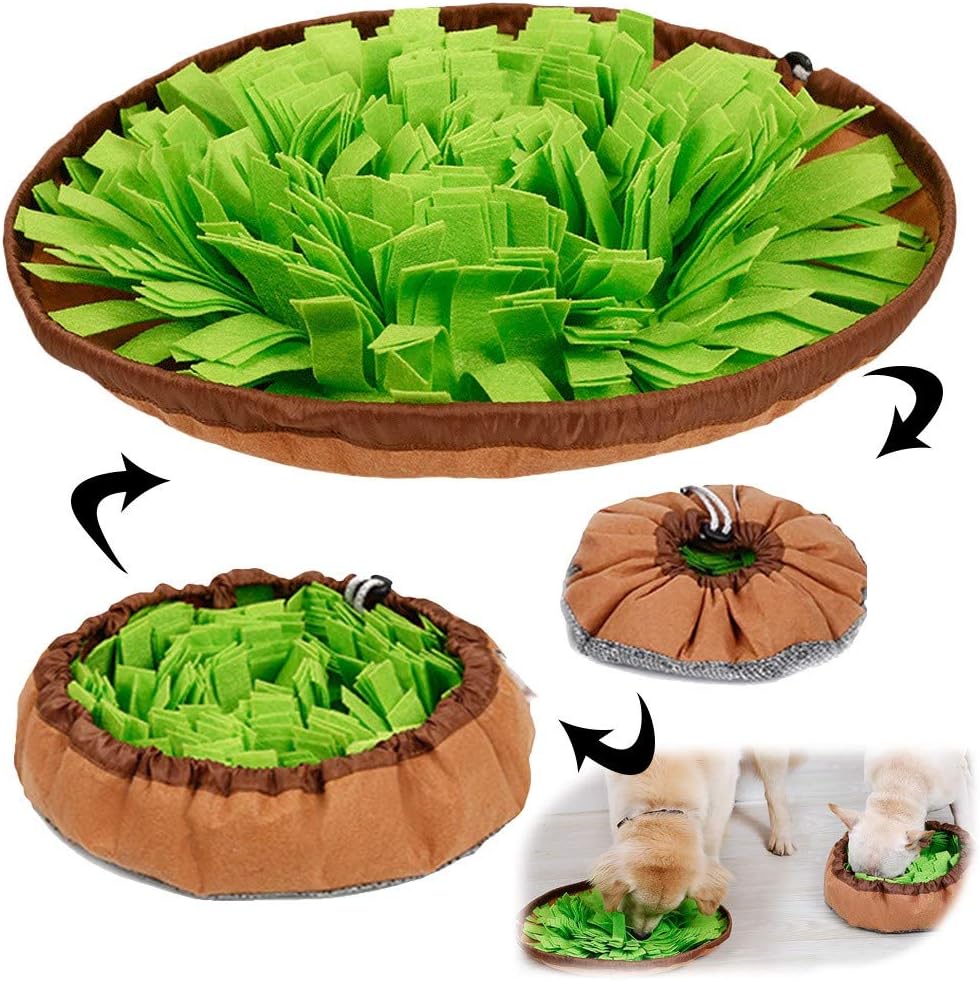
I started alternating it with a snuffle mat on odd days. The puzzle on Monday, the mat on Tuesday. The variety helped. The puzzle alone, by week 3, was losing him.
Day 30: what I'd do differently
If I were starting over, I would have bought two puzzles at the same difficulty level and rotated them from day one, instead of waiting until week 3 to add the mat. Novelty is what makes an affordable puzzle keep working — the same board every day gets solved, and once it's solved, it's just a food dispenser.
I would also have started with four loaded compartments instead of sixteen. The dog learns the mechanics faster when the reward density is lower, not higher. This is the opposite of what I assumed.
Who this is actually for
The DR CATCH is not the puzzle you buy if you want a single toy that lasts your dog's lifetime. It is the puzzle you buy if you want to find out whether your dog likes puzzles at all, before you spend real money on a Nina Ottosson level-3. At this price, if your dog ignores it, you're not out much. If your dog loves it, you've learned something useful about what to buy next.
For my dog, it was the gateway. He now has three puzzles and we rotate them. The DR CATCH is still in the rotation — it's the easy-day puzzle, the one I hand him when I need twenty minutes to finish a work call.
The gateway puzzle
The DR CATCH Dog Puzzle Toy is the one I'd hand anyone who isn't sure whether their dog will engage with food puzzles. The downside is small and the upside — finding out your dog is a puzzler — is worth it.
See the DR CATCH puzzle on Amazon →The bottom line
Thirty days in, the DR CATCH is not the puzzle my dog reaches for first anymore. But it is the one that taught me he would reach for puzzles at all, and it is the one that taught him how sliders and flip lids work, which made every harder puzzle since then faster to learn.
For the price and thirty days, that is a fair trade.