My dog lost his sight gradually, and for a while he managed by memory — he knew the house, the yard, the route to his bowl. What I did not plan for was that the puzzles he used by eye stopped working. The sliding-tile board he used to watch and then paw? He could not find the treats. The feeder he used to scan for the next kibble piece? He gave up.
The fix was rethinking enrichment around scent and sound instead of sight. Blind dogs are fully capable of puzzle work — they just need puzzles that do not ask them to see. These are the ones that worked.
1. Awoof Snuffle Mat — the scent-first puzzle
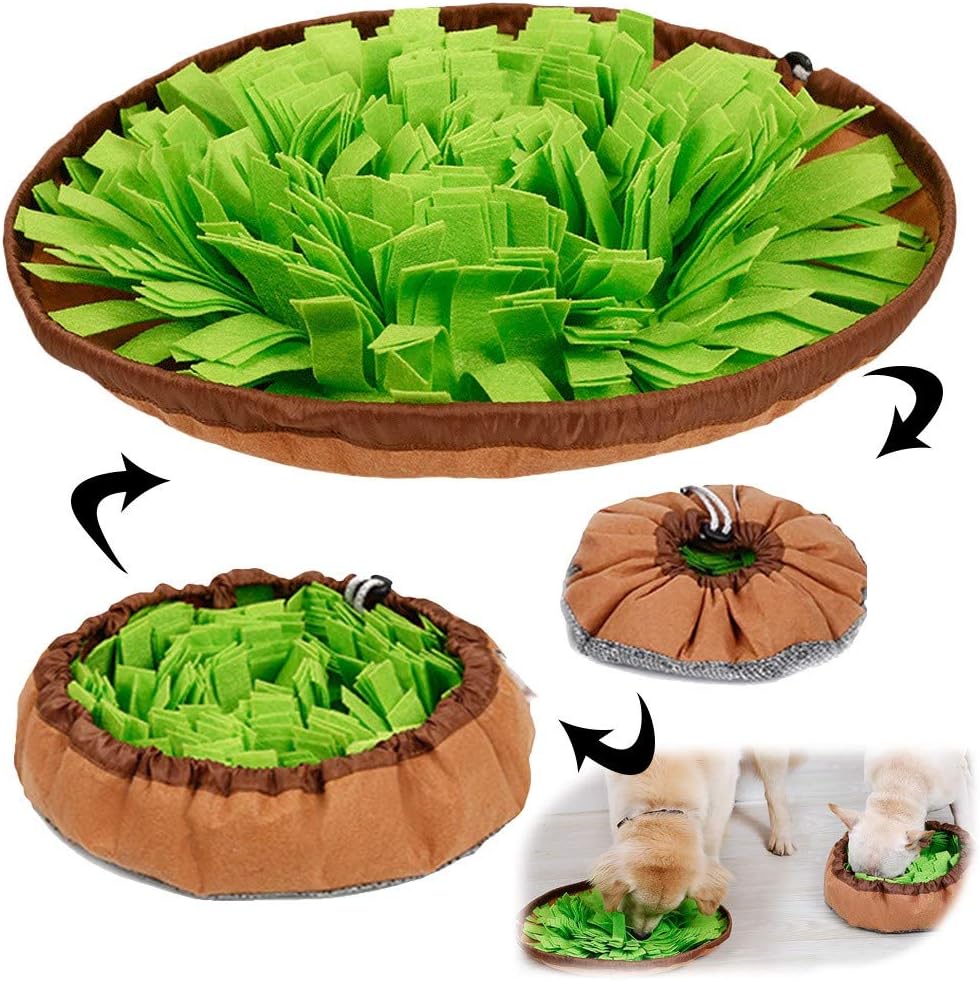
This is the one that saved my dog's enrichment. A snuffle mat is a fabric mat with fleece strips you bury kibble in, and the dog sniffs out each piece. It is entirely scent-based — there is nothing to see, nothing to paw at by eye.
For a blind dog it is perfect. My dog lies next to it and works it with his nose for 15 minutes, and it tires him out the way a walk used to. It also works on sore joints, which matters because a blind dog often moves less and stiffens up. If you buy one thing on this list, buy this one.
See the Awoof Snuffle Mat on Amazon → — see my full Awoof Snuffle Mat review.
2. KONG Classic — follow the smell
A KONG stuffed with strongly-scented food works for a blind dog because the dog tracks it by smell, not sight. I stuff mine with wet food or a smear of peanut butter, freeze it until firm, and the smell is enough for my dog to find it and work it empty.
The trick is scent. Plain dry kibble in a KONG has little smell and a blind dog loses interest. Something pungent — wet food, liver paste, cheese — keeps him on it for 20 to 30 minutes. Place it in the same spot each time so he learns where to expect it.
See the KONG Classic on Amazon → — see my full KONG Classic review.
3. West Paw Toppl — same idea, easier
The Toppl is the same concept as the KONG — a stuffable rubber toy — but with a wider opening, which makes it easier for a blind dog who cannot see what he is doing. He does not have to aim into a small hole; the food is right there under his nose.
I use it for softer fillings and shorter sessions. Stuff it with something smelly, set it in his usual spot, and let him work. It is dishwasher-safe, which is a bonus because scent-based fillings tend to be the messy ones.
See the West Paw Toppl on Amazon → — see my full Toppl review.
4. Outward Hound Slo Bowl — scent-guided eating
The Slo Bowl is a ridged feeder that makes a dog chase each piece of kibble around corners. For a blind dog it works because the kibble smells — he follows his nose around the ridges instead of scanning the bowl with his eyes.
It does need a little adaptation: use smellier food than dry kibble, or a few drops of warm water to bring the scent up. My blind dog worked it fine once the smell was strong enough to track. It also protects against the fast-eating bloat risk, which matters because a blind dog that gets suddenly uncomfortable and disoriented is a harder dog to help.
See the Slo Bowl on Amazon → — see my full Slo Bowl review.
What to skip
I would skip the sliding-tile puzzles like the Nina Ottosson Dog Brick for a blind dog. They rely on the dog seeing where the treat is hidden and watching the tiles move. A blind dog has no way to find the treat except random nosing, which is frustrating, not enriching. There are blind dogs who learn some tile puzzles by memory and sound, but it is a lot of work for a payoff the snuffle mat gives you immediately. Stick to scent.
Where I would start
The snuffle mat is the clear first buy for a blind dog — it is built around the sense he still has, and it gives the most brain work for the least setup. Add a scent-stuffed KONG for chewing and a Slo Bowl to slow meals, and you have his senses covered without asking him to see a thing.
Setting a blind dog up to succeed
Two small habits made puzzles work for my blind dog. First, always place the puzzle in the same spot — he learns where it is and goes to it, which removes the stress of searching. Second, let him sniff your hand after you have handled the toy or the food, so he can follow the scent. Do not move the furniture or the puzzle locations, because a dog navigating by memory relies on nothing having moved.
The bottom line
A blind dog does not stop needing a job — he needs a job that does not need eyes. Scent-based puzzles gave my dog his brain work back: a snuffle mat for the nose, a smelly KONG for chewing, a Slo Bowl for scent-guided meals. Start with the snuffle mat, keep the locations fixed, and your blind dog gets to keep the part of his day that made him tired and happy.