I have a dog who destroys things. Not "chews a little." Full disassembly. Stuffed toys last an afternoon. "Durable" rubber toys last a week if I am lucky. The ones marketed as "tough" usually just take him an extra day.
When a trainer friend told me the destruction was boredom, not malice, I went looking for puzzle toys — things that make a dog work for food instead of just handing it to him. I tested a dozen. These five are the ones I kept, ranked by what they are actually good at, not by what the packaging claims.
1. Outward Hound Fun Feeder Slo Bowl — the one for fast eaters
If your dog inhales food in 30 seconds and then looks at you like you stole the rest, this is the first thing to buy. It is a bowl with molded ridges that force the dog to chase each piece of kibble around corners instead of face-planting the whole meal.
My dog went from a 35-second meal to a six-minute meal. The rubber base means it does not skid across the floor, which matters more than you would think — a sliding bowl frustrates a dog into eating faster, not slower. Three years of daily use and it finally cracked, and I bought the same one again.
See the Slo Bowl on Amazon → — see my full Slo Bowl review.
2. KONG Classic — the one for chewers who would otherwise eat your sofa
This is not a puzzle in the slow-feeder sense. It is a rubber cone you stuff with food and freeze, and the dog has to chew and lick it empty. The genius is that a frozen KONG takes a heavy chewer 30 to 45 minutes, and during that time he is not available for trouble.
I stuff mine with wet food and a few kibble pieces, freeze overnight, and hand it over when I need to work. It is the single item that bought me back my afternoons. My dog has not destroyed his in two years, which is more than I can say for anything else he has owned.
See the KONG Classic on Amazon → — see my full KONG Classic review.
3. Awoof Snuffle Mat — the one for nose work
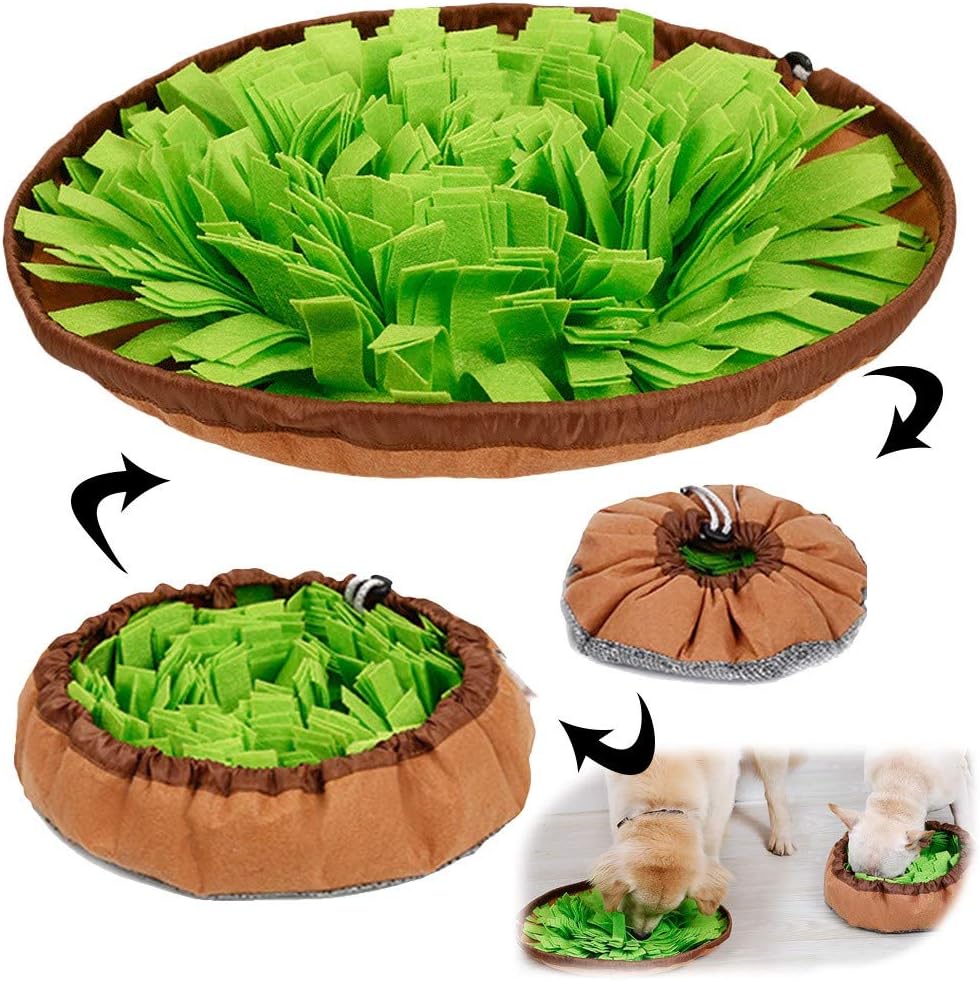
A snuffle mat is a fabric mat with strips of fleece you hide kibble in. The dog has to sniff out each piece. This is the closest thing to the hunt dogs were bred for, and it tires a dog out faster than a walk because nose work is mentally exhausting.
Mine gets deployed on rainy days when a real walk is not happening. Fifteen minutes of sniffing and my dog is asleep on the floor. It is also the gentlest option on this list — no hard plastic, no chewing required, just nose and paw. Good for older dogs or dogs with sore teeth.
See the Awoof Snuffle Mat on Amazon → — see my full Awoof Snuffle Mat review.
4. WOOF Pupsicle — the one for the dog who finishes everything too fast
The Pupsicle is a treat-dispensing toy you drop a pre-made treat into, and the dog works to get it back out. It occupies my dog for 20 to 30 minutes with one treat, which is a remarkable minutes-of-peace-per-dollar ratio.
The catch is that it takes proprietary treats (or you make your own with the mold they sell). Once you have a supply, it is the most reliable "I need 20 minutes" tool I own. It is the one I hand over on Zoom calls.
See the WOOF Pupsicle on Amazon → — see my full WOOF Pupsicle review.
5. DR CATCH Dog Puzzle Toy — the one for dogs who need to think
This is a sliding-piece puzzle — the dog pushes tiles around a board to reveal hidden treats. It is the hardest of the five and the one that most clearly makes a dog think. My dog stared at it for five minutes the first time before he worked out that the tiles move.
It is not for chewers — the tiles are plastic and a committed chewer could break them. It is for the dog who has figured out bowls and balls and needs a real problem. I use it once or twice a week as a "brain day" change of pace from the physical slow feeders.
Find the DR CATCH puzzle on Amazon → — see my 30-day DR CATCH diary.
Where I would start
If you only buy one, get the Slo Bowl for a fast eater or the KONG Classic for a chewer. The Slo Bowl solves the medical-adjacent bloat risk; the KONG buys you your afternoons back. Together they cover most of what a bored dog needs.
How to actually use these
Do not hand a dog all five at once. Rotate them. One puzzle per meal, a different one each day. A puzzle the dog sees every single day loses its challenge after a week; a puzzle he sees twice a week stays interesting for months.
And do not let him win too easily or lose too hard. If he solves it in 30 seconds, it is too easy. If he walks away frustrated, it is too hard. The sweet spot is 10 to 20 minutes of working, then success.
The bottom line
A bored, fast-eating, destructive dog is usually not a bad dog — he is a dog with nothing to do. These five toys are the ones that gave my dog a job, and in doing so gave me back a couch that still has cushions. Start with the Slo Bowl or the KONG, and add the rest as rotation.