
I have a pug named Walter. Walter eats the way pugs do everything — loudly, joyfully, and with total disregard for his own anatomy. For the first year I had him, I thought his 25-second kibble times were just a pug being a pug. Then a vet mentioned bloat, and the words "gastric dilatation-volvulus" landed the same way they land for any deep-chested breed owner. Pugs are not classic bloat candidates, but they are champion air-swallowers, and the coughing and gagging after meals were not a quirk. They were a symptom.
So I went looking for a slow feeder. And that is where the pug problem starts, because almost everything sold as a "slow feeder" is designed for a dog with a snout.
Why pugs break the standard slow feeder
Most slow feeders slow a dog down by making the food hard to reach. Deep ridges, maze channels, spinning layers — all of these assume the dog can get his muzzle down into the bowl and his tongue around a corner. A pug's face is flat. His oral cavity is compressed, his tongue is relatively short for his body, and his airway is already narrow. A bowl that makes a Labrador work for his food makes a pug work so hard he gives up.
When a pug gives up and walks away from a feeder, two bad things happen. First, he does not eat — and a pug skipping meals is a pug you need to watch. Second, the frustration spikes his arousal, which is the opposite of what you want from a tool meant to calm mealtime down.
The second problem is airway. Deep-ridged bowls make a pug bury his face to reach food, and a pug with his face buried in a bowl is a pug breathing against a flat surface. That is stressful on a brachycephalic airway at best and a genuine risk at worst.
So the rule for pugs is the opposite of the rule for most dogs: you want shallow, wide, and flat. Not deep, not tall, not spinning.
The bowl I actually use
After trying five, the one that worked is the Outward Hound Fun Feeder Slo Bowl in the small size. Not the large, and not the medium with the deep ridges — the small, which has shorter ridges and a shallower profile than the photos suggest once you have it in your hand.
The one that worked for my pug
The Outward Hound Fun Feeder Slo Bowl in small is the only deep-ridged slow feeder Walter would actually use. The small size has shorter ridges than the medium and large, so his flat face could reach the kibble without burying his nose.
See the small Slo Bowl on Amazon →The reason it works is the ridge height. In the small size, the tallest ridge is maybe an inch. Walter can get his tongue over it without compressing his airway against the bowl floor. He still has to chase the kibble around the maze, which slows him from 25 seconds to about three and a half minutes — not as dramatic as the 10x slowdown you see in a Labrador, but enough that the post-meal coughing stopped.
The rubber base matters here too. Pugs push with their faces. A bowl that slides is a bowl that a pug will chase across the kitchen, which is both pointless and a little sad. The Slo Bowl does not move.
What I would use if I were starting over
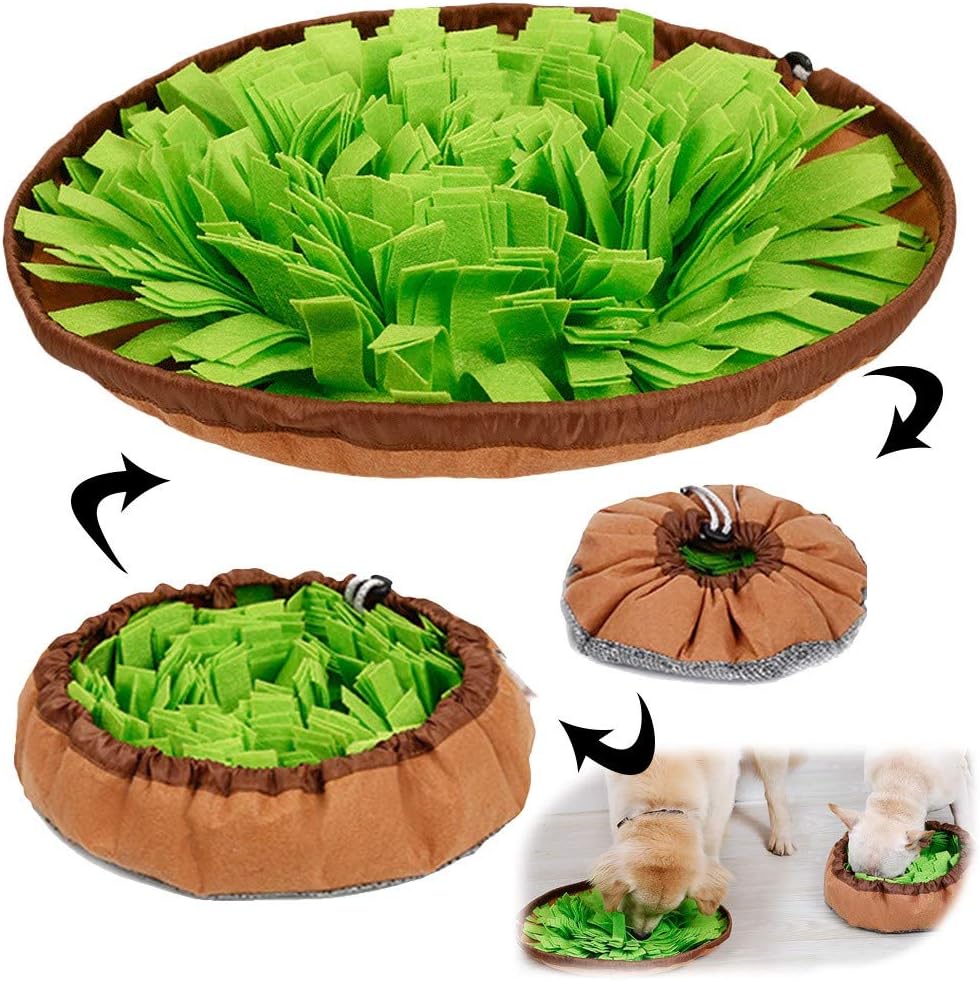
If Walter had not taken to the Slo Bowl, my next move would not have been a deeper bowl. It would have been a lick mat. A lick mat is the honest answer for a flat-faced dog. You spread wet food, yogurt, or peanut butter into the textured surface and the dog licks it clean. There is no reaching, no burying, no ridge to get over. The licking motion itself is slow — a pug will spend five to ten minutes on a smeared mat where he would spend thirty seconds on a bowl of kibble. Licking is also self-soothing, which is a bonus for a breed prone to excitement.
The flat-faced fallback
If your pug refuses any ridged bowl, skip the bowl entirely. A LickiMat smeared with wet food or plain yogurt slows a pug down more reliably than any deep feeder, and the licking motion is gentle on a compressed airway.
See the LickiMat 2-pack on Amazon →The KONG Classic in the small size is the other flat-faced option. Stuffed and frozen, it slows a pug down for ten to fifteen minutes and doubles as a chew. The trade-off is that a KONG is a snack delivery system, not a meal bowl — you cannot feed a full cup of kibble out of one. Use it for the evening wind-down, not breakfast.
What to avoid with a pug
The tall spinning feeders — the ones with rotating compartments on a central spindle — are the worst choice for a pug. They require the dog to push the spinner with his nose, and a pug's flat face has nothing to push with. He will either give up or tip the whole thing over.
Heavy ceramic slow bowls look calm and aesthetic on a kitchen floor, but they are usually deep and the weight does nothing a rubber base does not do better. Skip them for brachycephalic dogs.
Anything labeled "level 3" or "advanced" puzzle difficulty is a hard no for a pug at mealtime. Those are for mental enrichment sessions, not for feeding, and the frustration level is too high for a flat-faced dog trying to eat.
How to introduce it
Pugs are stubborn and they form opinions fast. Do not swap bowls cold turkey. The first meal, put half the kibble in the Slo Bowl and half in his old bowl next to it. Let him choose. He will eat the easy half first, then reluctantly figure out the slow half because he is a pug and food is food. By the third meal, drop the old bowl entirely.
If he refuses the Slo Bowl outright, smear a thin layer of wet food along the shallowest ridges for the first week. The smell pulls him back. Once he is working the bowl confidently, switch to dry kibble only. If he still refuses after a week, stop fighting the bowl and move to a lick mat — he is telling you his airway cannot handle the ridges, and you should listen.
The honest answer
If someone asks me for the single best slow feeder for a pug, my answer is "it depends on your pug." Walter does fine with the small Slo Bowl. My friend's pug refused it in one meal and switched to a lick mat the same week, and that pug is healthier for it. The honest guidance is: try the small Slo Bowl first because it is cheap and it works for most pugs. If yours is the flat-faced kind that will not bury his nose in a ridge, go straight to a lick mat and stop buying bowls.
The one thing not to do is buy the large, deep-ridged feeder that the marketing photos make look impressive. That bowl is for dogs with snouts. Your pug does not have one.